Composite vs Vinyl Fence in Colorado: What Actually Holds Up
· Buying Guide
Trex composite or aluminum-reinforced vinyl for a Front Range fence? We compare them by the forces that decide it here: altitude UV, cold flex, and hail.
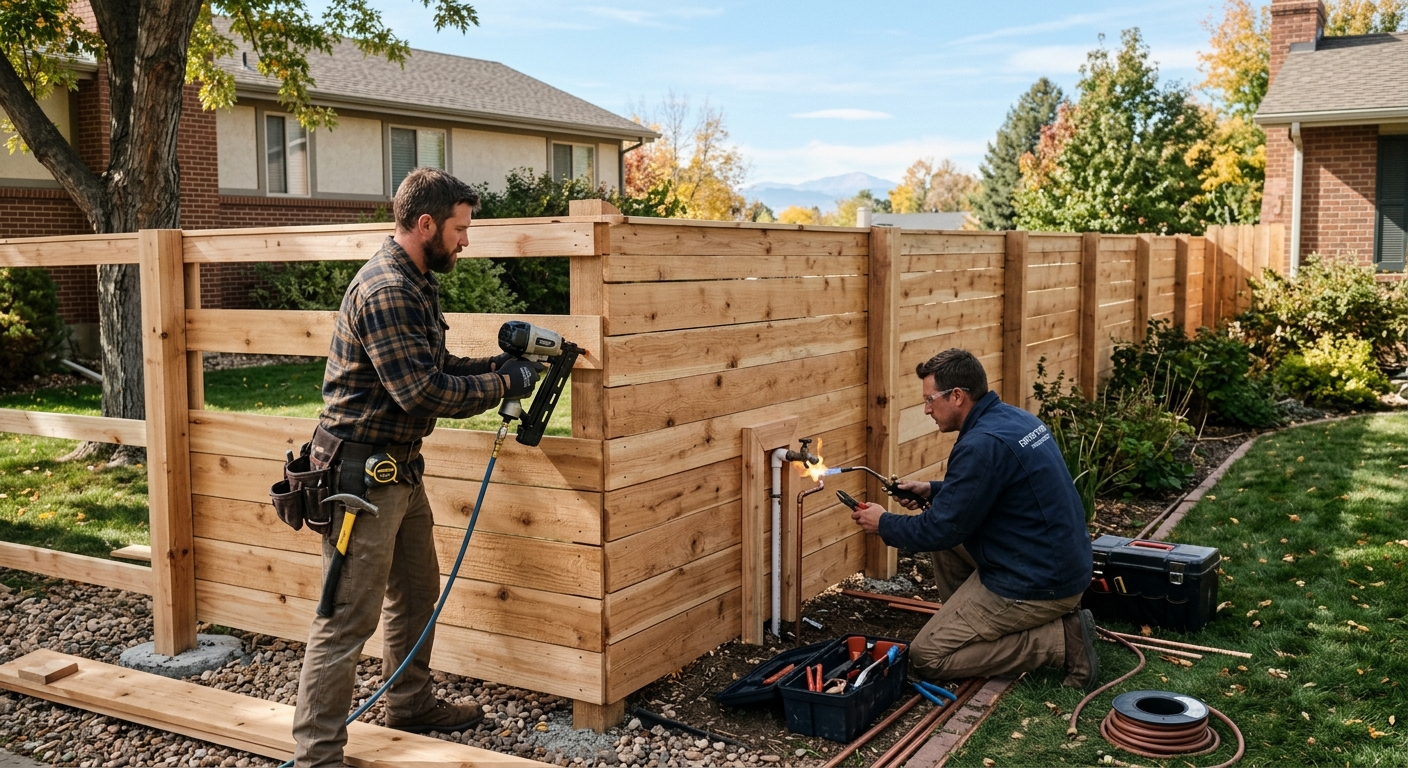
<p>Here is the frame most composite-versus-vinyl guides get wrong: they treat it as a fight one material wins. On the Front Range it isn't. Both capped composite and aluminum-reinforced vinyl survive here for 25-plus years when they're built right, and both fail fast when they're the cheap version. The real decision isn't which material is tougher. It's which set of trade-offs fits your yard, your look, and your HOA, once you account for the three forces that actually punish a fence at 5,280 feet: high-altitude UV, roughly 150 freeze-thaw cycles a year, and spring hail.</p>
<p>We are J.A's Privacy and Perimeter, owned by Julian Lopez, and we install both across Denver, Aurora, Lakewood, Thornton, Arvada, and Westminster. After 15+ years setting posts in metro clay, we've stopped framing this as composite versus vinyl and started framing it as "what do you want to stop thinking about." Here is the comparison the way we lay it out on an estimate visit.</p>
<h2>Vinyl and Composite Fences in Colorado: What Actually Decides It</h2>
<p>Both materials clear the same bar most homeowners care about: no staining, no board rot, no graying, and a service life north of 25 years when the posts are set to frost depth. So the choice comes down to three things, and none of them is durability.</p>
<p>The first is the look. Composite is the one to pick when you want a fence that reads as real wood grain, warm brown tones, board texture, the appearance of cedar without the every-two-to-three-year re-stain that cedar needs in this sun. That's the whole point of Trex composite fence installation in Denver: the wood-tone cap is baked into the panel, so it holds color at altitude instead of fading. Vinyl reads as vinyl. Clean, uniform, usually white or tan, and it's the right call when you want a fully synthetic look and don't need the fence to imitate wood.</p>
<aside class="my-6 rounded-md border border-border bg-card p-4 text-sm">Front Range reality: at 5,280 feet, UV runs roughly 20 to 25 percent stronger than at sea level. That's the force that fades cheap uncapped composite and yellows non-UV-inhibited vinyl. The premium version of each material is engineered specifically to survive it, and the cheap version of each is not.</aside>
<p>The second is cost shape. Composite typically costs more up front than basic vinyl, though both cost more than cedar on day one. Over a 10-year window the maintenance column is near-zero for either, so the upfront number is most of the story. The third is HOA fit, and that one flips depending on your covenants, which we'll get to. But the honest headline is this: neither material is "better." They solve different problems, and picking off a generic chart is how people end up with the wrong one on their lot.</p>
<h2>Is Trex Composite Fence Better Than Vinyl in Cold Weather?</h2>
<p>Both handle Colorado cold well when they're the quality grade, but they handle it differently, and the difference is what fails when they're cheap. Composite is a dense wood-and-plastic blend, so it expands and contracts with temperature more than most homeowners expect. That thermal movement is not a defect. It's why we leave manufacturer-specified gaps at the panel ends during install, so a panel that grows on a 90-degree July afternoon and shrinks on a 5-degree January night has somewhere to go. Skip those gaps and a composite fence buckles or gaps at the seams through the season. That's an installation variable, not a material one.</p>
<blockquote class="my-6 border-l-4 border-primary pl-4 italic text-foreground/85">"The composite failures we get called to fix are almost never the panels. They're an installer who didn't leave room for thermal expansion, or posts that heaved because the footing was shallow. The material does its job. The build has to match it."</blockquote>
<p>Vinyl's cold-weather story is about what's inside the panel. The aluminum-reinforced vinyl and PVC fencing we install, CertainTeed Bufftech, ActiveYards, and Ply Gem, uses impact modifiers that keep the panels flexible down to 30 degrees below zero instead of turning brittle in a hard freeze. Cheap big-box vinyl skips those modifiers. Without them it goes glass-brittle in a cold snap and shatters on a hail strike instead of flexing. We've documented exactly that failure on unreinforced panels in Stapleton, product that cracked after a single hail season. So the honest answer to "is composite better in cold" is: neither is better, but both have a specific way they fail cheap. Composite fails on a bad install, vinyl fails on missing additives. Get the quality grade of either and cold isn't your problem.</p>
<h2>The Install Is Where Both Materials Actually Live or Die</h2>
<p>Material choice gets the attention, but on the Front Range the footing decides whether either fence survives. Much of central and south Denver, Capitol Hill, Wash Park, and the clay-to-loam transition through western Aurora, sits on expansive bentonite clay that swells wet and shrinks dry. The metro runs roughly 150 freeze-thaw cycles a year, and each one is a chance to lift a shallow post.</p>
<p>Composite panels are heavier than cedar boards and vinyl, so a footing that heaves takes a composite run out of plumb faster than it would a lighter fence. Here's how we neutralize that on both materials:</p>
- We set steel-reinforced posts a minimum of 36 inches deep to hit the local frost line, 42 inches in the heaviest clay zones like Wash Park.
- We backfill with a gravel-and-concrete drainage sandwich so meltwater sheds sideways instead of pooling and freezing against the post base.
- We let footings cure a full 24 to 48 hours before panels go up, because skipping the cure window is exactly how posts heave in the first spring.
<aside class="my-6 rounded-md border border-border bg-card p-4 text-sm">The part nobody quotes: the most common composite and vinyl failures we're called to repair aren't the panels at all. They're posts set shallow or dry-packed by a crew moving fast. Julian sets the posts himself and walks the finished fence with you. There's no subcontracting layer between the person who quoted the job and the crew that built it.</aside>
<h2>When Neither Composite Nor Vinyl Is the Right Call</h2>
<p>Here's the section a company chasing the lead won't write. Don't buy composite or premium vinyl if what you actually want is a rustic split-rail or ranch-style look, that's a cedar job, and dressing it up in synthetic material fights the whole aesthetic. Don't buy either if your budget is genuinely tight and you're fine re-staining, because #1 grade cedar costs less up front and lasts 15 to 20 years here. And if you need a barbed-wire topper for a commercial perimeter, neither composite nor vinyl is engineered for that attachment, that's a chain link base system. We'd rather point you to the right material than sell you the wrong one because it carries a bigger ticket.</p>
<h2>Composite Fence in Denver: How the HOA Question Flips the Answer</h2>
<p>For a lot of Denver-metro homeowners, the HOA is the tiebreaker, and it can push you either way. If your Architectural Review Committee mandates a fence that reads as wood, a specific board-approved brown, composite wins cleanly, because the wood-tone finish is in the cap layer rather than painted on, so it stays compliant without the color maintenance a stained cedar fence needs. If your covenants call for a uniform white or tan synthetic look, vinyl is the natural fit. We prepare the ARC package in-house the way Denver-area committees expect, spec by spec, and we keep current spec sheets for 30+ Aurora HOAs so the profile we submit already matches your community's approved options instead of getting kicked back for more detail.</p>
<p>So which one should you choose? Choose composite if you want the look of real wood you never stain and your HOA reads warm-toned. Choose aluminum-reinforced vinyl if you want a fully synthetic fence, don't need the wood look, and value the clean uniform finish. Either way the install standard doesn't move: quality grade only, steel-reinforced posts to frost depth, real cure window, and thermal gaps sized to the material. Get those right and both fences will outlast the generic-chart version of themselves by a decade.</p>
Frequently Asked Questions
Is a Trex composite fence better than vinyl in cold weather?
Neither is categorically better in cold, but they behave differently and fail differently when they're the cheap grade. Quality vinyl with impact modifiers, the CertainTeed Bufftech, ActiveYards, and Ply Gem lines we install, stays flexible down to 30 degrees below zero rather than turning brittle in a hard freeze, so it flexes on a hail strike instead of shattering. Composite handles Colorado cold fine as a material, but it expands and contracts with temperature more than homeowners expect, which is why it has to be installed with manufacturer-specified thermal gaps at the panel ends. Set those gaps correctly and a composite fence rides out the swing from a 90-degree July afternoon to a 5-degree January night without buckling or seam gaps. So the honest read is: vinyl's cold weakness is missing additives on cheap product, composite's is a bad install. Pick the quality grade of either and set it right, and Front Range cold isn't the thing that fails your fence. Shallow footings are.
Does composite fencing fade at Colorado altitude?
Cheap uncapped composite fades fast at altitude. Capped composite, the only kind we install, does not. At 5,280 feet UV runs roughly 20 to 25 percent stronger than at sea level, and that high-altitude sun is exactly what washes uncapped boards to a gray, blotchy finish within a few seasons. Capped composite wraps every board in a UV-stabilized polymer shell, so the wood-tone color is protected against that exposure and holds through Colorado summers without the re-stain a cedar fence needs every two to three years. That UV stabilization is the whole reason to choose composite over wood on the Front Range: you get the cedar look without the color maintenance the altitude would otherwise force on you. If a contractor quotes composite lower than the going rate, the first question to ask is whether the boards are capped, because uncapped is where the corner usually gets cut, and it's the corner that fades.
Ready to decide between composite and vinyl for your lot? Julian measures every job in person and gives you a straight material recommendation before anyone quotes a dollar. Call 720-609-6094 Monday through Friday, 7 a.m. to 6 p.m., for a free, no-obligation estimate, or request a quote through our <a href="/contact">contact page</a> and we'll come back with an honest number for your specific property.